
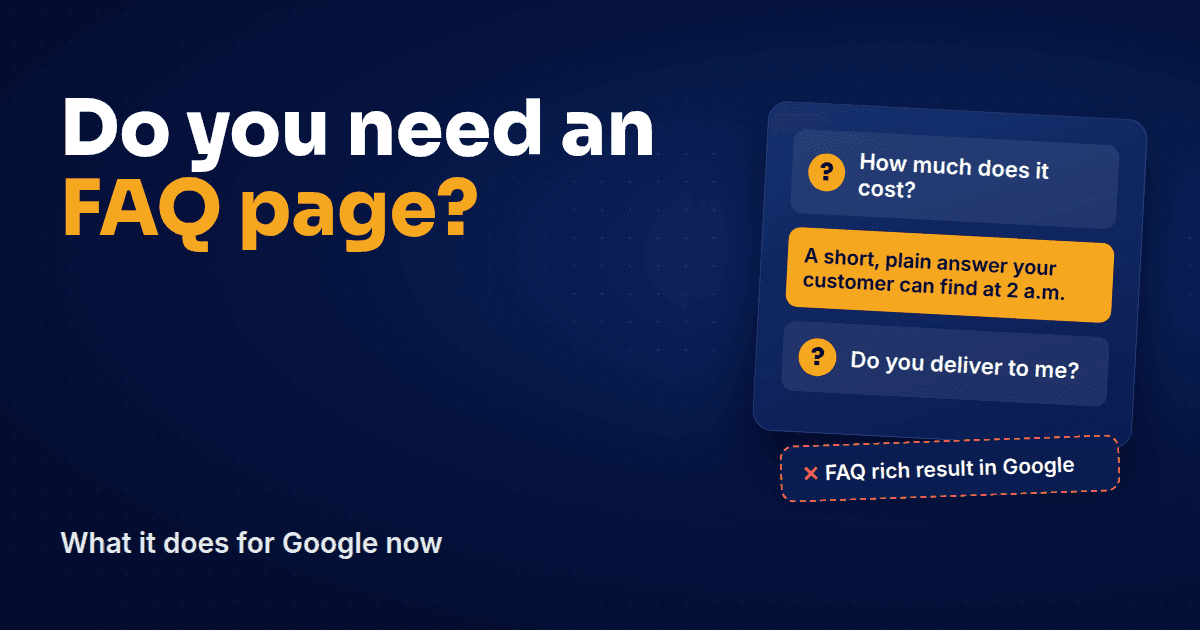
Do you need an FAQ page? What it does for Google now
"My developer says to add FAQs to rank higher. Is that still true?" We hear this a lot, and the honest answer changed in 2026. An FAQ page can still be very useful, but not for the reason it used to be recommended.
What Google changed
Google's FAQ page now carries a notice, dated 8 May 2026, saying the FAQ rich result "will no longer appear in Google Search results starting May 7, 2026". On 15 June 2026 Google went further and removed the FAQ documentation, stating that the FAQ rich result feature is no longer shown in Search results.
The FAQ rich result was the expandable question-and-answer panel that sometimes appeared under a page's listing. Developers often added special structured data (FAQ markup) to a page to try to earn it.
This did not happen overnight. In August 2023 Google had already said FAQ rich results would "only be shown for well-known, authoritative government and health websites". For most small business sites, the feature had been rarely visible for some time before it was switched off completely.
What this means for your site
Adding FAQ markup will not give you that rich result. If someone sells you FAQ structured data as a way to stand out in Google, that feature no longer exists.
You do not need to rush to remove existing markup. In the same 2023 announcement, Google said "there's no need to proactively remove it", and that unused structured data does not harm Search. If your site already has it, you can leave it alone.
Writing an FAQ page is still worthwhile. Nothing in Google's change says that answering customer questions on your site is a bad idea. It simply means the reason should be your customers, not a Google feature.
Why a good FAQ still earns its place
The Nielsen Norman Group (NN/g), a respected usability research firm, explained the value of FAQs well in an article by Susan Farrell from December 2014. A good FAQ is based on what users actually ask, and it can answer routine questions around the clock. That reduces the load on whoever answers your phone and email.
For a small business, that is a real gain. If you keep being asked about opening hours, delivery areas, how bookings work or what is included in a price, a clear answer on your website saves time for you and for the customer.
How to write an FAQ people use
NN/g's guidance gives a practical checklist.
Start with real questions. Collect what customers genuinely ask you, in emails, calls, messages and conversations. Do not invent questions to fill space.
Use your visitors' words. NN/g says "the questions should reflect the vocabulary and phrasing of your visitors". If customers say "How much does it cost to fix a leak?", do not title it "Remedial plumbing fee structure".
Group by topic when the list is long. NN/g recommends that large FAQs be "chunked by topic and designed to be visually scanned". Short headings such as Prices, Bookings and Delivery help people find their answer without reading everything.
Be honest about limits. NN/g advises openly acknowledging known problems or limitations. If you do not cover a certain area, or something takes longer than people expect, say so. Visitors trust a straight answer more than a gap.
A simple plan
- 1Gather the ten questions you answer most often.
- 2Write each question the way a customer would say it.
- 3Give a short, direct answer, and link to the relevant page if there is more detail.
- 4Group the questions under a few clear headings.
- 5Add a route to reach you for anything not covered.
- 6Revisit the page every few months as new questions come in.
The bottom line
Google has stopped showing FAQ rich results, so FAQ markup no longer earns that panel. But a page that answers real customer questions in plain words is still good for the people who visit your site, and good for your own time. Write it for them.
If you would like help planning or building a useful FAQ page, contact us.
Continue Reading
Discover more insights and stories